

The U.S. Natural and Organic market is transitioning from a high-growth insurgent channel into a structurally important—but increasingly competitive—component of total CPG. Once defined by rapid household penetration gains and premium-price insulation, the category is now navigating a more complex environment shaped by macroeconomic pressures, channel blurring, and evolving consumer definitions of health.
The U.S. Natural Products Industry is a Force
The industry has grown 545% since 2001, from $53B to over $342B in 2025.

The industry’s growth continues to accelerate, attracting more buyers and trips. Growth has moderated but remains resilient relative to conventional CPG, supported by enduring demand for clean-label, ingredient-transparency, and functional benefits. However, the sources of growth have shifted.

Natural and organic products are experiencing strong momentum, with broad household penetration, increased shopping frequency and spend per trip, and double-digit dollar growth (+10%) alongside solid unit gains (+7%) over the past year.

Shoppers are Buying More Natural Products
U.S. shoppers are spending nearly 10% more than last year on natural products, and where they are spending those dollars is evolving.
 Natural supermarkets are growing, driven by more household penetration and buyer count. While Club stores continue to make strong strides with natural shoppers, followed by online and Walmart purchases. Consumers are more educated and more willing to seek out natural and premium products from a variety of retailers.
Natural products (the ‘NPI’) continue to outpace other products across most SPINS-tracked channels. The Natural Channel continues to lead overall retail growth.

The K-Shaped Economy
Numerous economists have been discussing the K-shaped economy, which describes a recovery where different segments diverge—some groups experience growth and gains, while others face stagnation or decline.


The Shopper of the Next Five Years
Given social, macro-economic, and current global events, you might think we are a little crazy here at SPINS to be talking about the shopper of the next five years, yet here we are attempting to do so.
Values-driven shopper preferences for health, sustainability, and transparency, combined with the growing influence of agentic commerce, will transform how brands and retailers grow within the next five years.

Shoppers are becoming more digitally enabled and less brand loyal. Personalization, AI-assisted discovery, and omnichannel shopping are reshaping decision-making, shifting influence away from traditional shelf dynamics toward algorithms, targeted promotions, and digital ecosystems. As a result, brands must consistently prove their value at every point of purchase, as switching costs continue to decline.
In this environment, winning brands will deliver clear, differentiated value propositions that balance function, trust, and price in a fragmented, increasingly competitive marketplace.
Ingredients and Choosing
Ingredients are an important factor in terms of price and taste when choosing a new or premium brand.

Nutritional claims and free-from/clean ingredients are top of mind for the conscious consumer.

This shift in shopper behavior is creating a growing disconnect between what consumers now expect and what many CPG portfolios currently deliver. As needs become more functional, personalized, and value-driven, an innovation gap is emerging in which existing products and pipelines are not fully aligned with these evolving demand drivers.
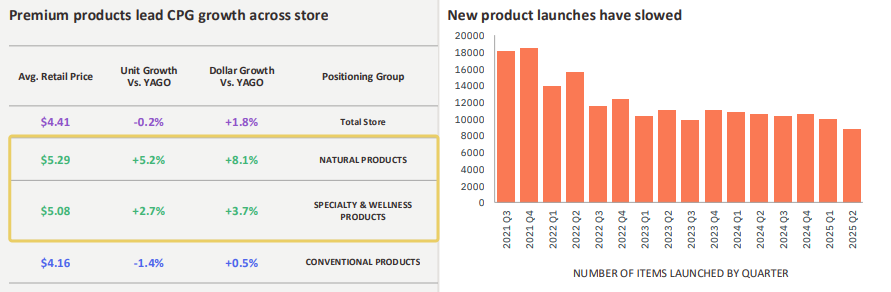
While innovation in products launched has been lackluster in recent years, we are currently entering a period of rapid transformation in how we shop.
How We Shop

Blending preference-based consumption, non-human participation, and anywhere commerce. Successful retailers of tomorrow will include these elements in their shopper experience.

The food, beverage, and supplements industry will need to continue pushing boundaries beyond the retail environment. What has long been the norm for the natural segment is now going mainstream.

The lack of or removal of ultra-processed foods, seed oils, and artificial ingredients has been a mainstay of the natural and organic space for some time. They have entered political discourse and mainstream conversation as consumers across the spectrum seek healthier options. The need for brands and retailers to further differentiate themselves from avoidance products and educate consumers will be a key component to continued growth.
Conclusion
The natural and organic landscape is in a state of change and poised for significant growth. Taken together, the convergence of a K-shaped economy, evolving shopper expectations, and shifting perceptions of health and ingredients is fundamentally reshaping the CPG landscape. Growth is no longer evenly distributed—consumers are simultaneously trading up and down, becoming more selective, less loyal, and increasingly focused on functional benefits, transparency, and perceived value. At the same time, heightened scrutiny around ultra-processed foods, seed oils, and artificial ingredients is accelerating demand for simpler formulations and clearer brand positioning.
This dynamic is exposing a clear innovation gap: many existing products and pipelines are not fully aligned with how consumers now define value—where performance, trust, and price accessibility must coexist. Winning in the next phase of CPG will require precision—brands must deliver differentiated, benefit-driven innovation while navigating polarization in consumer beliefs and mounting economic pressures. Those that can effectively bridge this gap—balancing premiumization with accessibility and clarity with credibility—will be best positioned to capture the next wave of growth.
Sources:
Attribute Ticker

Data Ticker


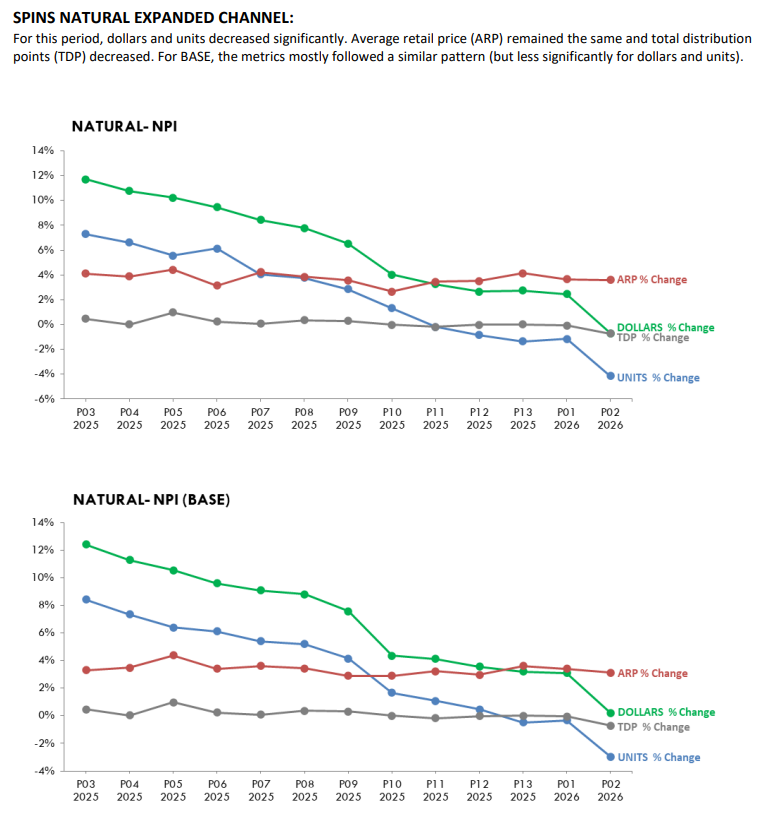
Below we break out total MULO with Natural Products, Total MULO Base, Total Natural Expanded with Natural Products, and Total Natural Expanded Base.

 Looking for more information? Please get in touch with the SPINS Account Manager for PRESENCE, Hans De Schaaf, at hdeschaaf@spins.com.
 (847) 277-9500